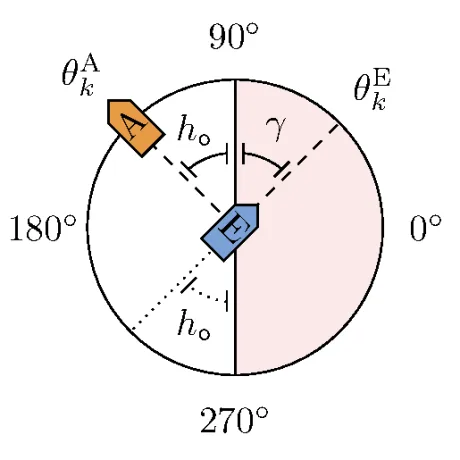
Compliance with maritime traffic rules is essential for the safe operation of autonomous vessels, yet training reinforcement learning (RL) agents to adhere to them is challenging. The behavior of RL agents is shaped by the training scenarios they encounter, but creating scenarios that capture the complexity of maritime navigation is non-trivial, and real-world data alone is insufficient. To address this, we propose a falsification-driven RL approach that generates adversarial training scenarios in which the vessel under test violates maritime traffic rules, which are expressed as signal temporal logic specifications. Our experiments on open-sea navigation with two vessels demonstrate that the proposed approach provides more relevant training scenarios and achieves more consistent rule compliance.

Marlon Müller
I'm an MCML PhD student in the Cyber-Physical Systems Group of Matthias Althoff. I work on neurosymbolic learning for robotics. In 2024, I visited the research group of Murat Arcak at UC Berkeley, and in 2023, I spent a semester at UQ. I did my B.Sc. and M.Sc. in Computer Science at TUM.
Publications
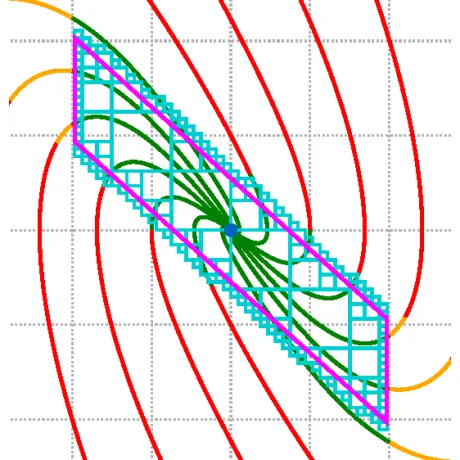
Ensuring the safety of reinforcement learning (RL) algorithms is crucial to unlock their potential for many real-world tasks. However, vanilla RL and most safe RL approaches do not guarantee safety. In recent years, several methods have been proposed to provide hard safety guarantees for RL, which is essential for applications where unsafe actions could have disastrous consequences. Nevertheless, there is no comprehensive comparison of these provably safe RL methods. Therefore, we introduce a categorization of existing provably safe RL methods, present the conceptual foundations for both continuous and discrete action spaces, and empirically benchmark existing methods. We categorize the methods based on how they adapt the action: action replacement, action projection, and action masking. Our experiments on an inverted pendulum and a quadrotor stabilization task indicate that action replacement is the best-performing approach for these applications despite its comparatively simple realization. Furthermore, adding a reward penalty, every time the safety verification is engaged, improved training performance in our experiments. Finally, we provide practical guidance on selecting provably safe RL approaches depending on the safety specification, RL algorithm, and type of action space.
Teaching
- Fundamentals of Artificial Intelligence
- Formal Methods for Cyber-Physical Systems
- Safe Reinforcement Learning for Modular Robots
- Cyber-Physical Systems
© 2026 Marlon Müller